Ad Blocker Detected
Our website is made possible by displaying online advertisements to our visitors. Please consider supporting us by disabling your ad blocker.
When considering power solutions for portable or stationary needs, we recognize that both portable power stations and deep cycle batteries have unique technical advantages and limitations. Understanding how each system operates, their efficiencies, and suitability for different applications is essential for making an informed choice. As we analyze their features and long-term performance, we’ll uncover which setup aligns best with your specific power demands and operational context—an evaluation vital for optimizing your energy management strategies.
Key Takeaways
- Portable power stations are self-contained units with built-in inverters and outlets for immediate use; deep cycle batteries require external systems and setup.
- Power stations offer higher portability, quick deployment, and user-friendly interfaces, ideal for on-the-go applications.
- Deep cycle batteries are better suited for stationary, long-term energy storage in renewable or off-grid systems.
- Power stations typically have higher initial costs but lower maintenance; deep cycle batteries may need frequent replacements.
- Choose power stations for convenience and mobility; select deep cycle batteries for sustained, high-capacity energy needs.
How Do Portable Power Stations Work and What Are Their Benefits?
Portable power stations operate as self-contained energy units that store electrical power in integrated batteries, which can then be distributed to various devices via built-in outlets and USB ports. They often feature solar integration, allowing users to recharge via solar panels, enhancing sustainability and off-grid usability. This integration extends the system’s flexibility and reduces reliance on grid power. The design emphasizes efficient energy management, but battery lifespan remains critical; high-quality batteries degrade gradually over time, affecting overall performance. Proper utilization of solar input can help mitigate this, as solar recharging supports battery longevity and reduces wear caused by frequent cycling. Overall, portable power stations provide a reliable, versatile energy solution with thoughtful consideration of solar integration and battery lifespan to optimize long-term functionality.
What Are Deep Cycle Batteries and When Should You Use Them?
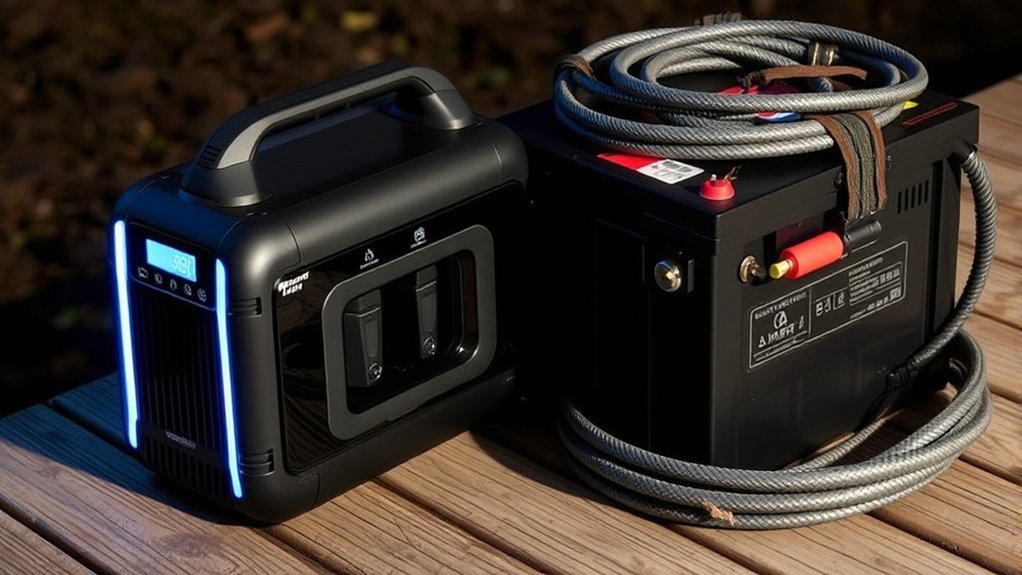
Deep cycle batteries are specialized energy storage devices designed to deliver a steady, reliable current over extended periods, making them essential for applications requiring sustained power output. Their battery chemistry, often lead-acid or lithium-ion, influences performance, lifespan, and maintenance needs. Deep cycle batteries excel in providing consistent power through deep discharges, unlike standard batteries meant for short bursts. Proper charging methods are critical; they typically involve controlled, slow charging to prevent damage and ensure longevity. Lithium-ion variants offer faster charging and higher efficiency, while lead-acid models are more cost-effective but require careful maintenance. You should utilize deep cycle batteries when your application demands long-duration energy, such as renewable energy systems, marine applications, or off-grid setups, where dependable, repeated deep discharges are necessary.
Comparing Portability, Power Output, and Ease of Use
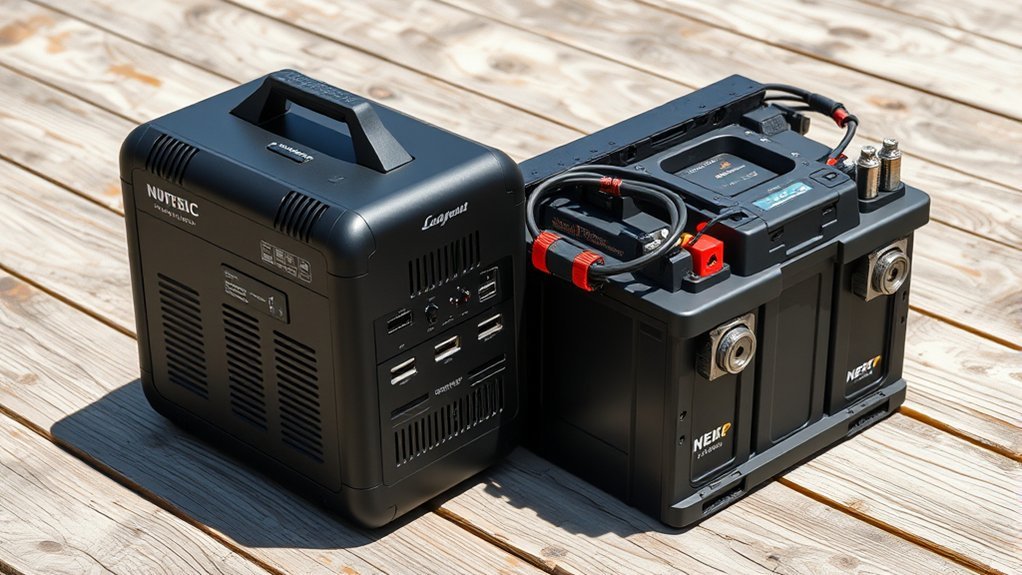
We compare portable power stations and deep cycle batteries by examining their size and weight, which influence ease of transport and installation. We also analyze their power capacities and typical applications to determine suitability for various energy demands. Additionally, we evaluate setup complexity and user interface design to assess overall practicality for end-users.
Portability and Size
How do portable power stations compare to deep cycle batteries regarding size, ease of handling, and power delivery? Portable power stations are generally larger, incorporating integrated inverters and displays, making them less portable but easier to use on-site. Deep cycle batteries are more compact, lightweight, and suited for permanent or semi-permanent setups, but handling them requires caution. The battery chemistry influences environmental impact, with lithium-ion stations offering cleaner operation than lead-acid deep cycle batteries, which produce more hazardous waste. The table below summarizes these aspects:
| Feature | Portable Power Station | Deep Cycle Battery | Implications |
|---|---|---|---|
| Size | Larger, integrated design | Compact, modular | Handling ease, transportability |
| Battery Chemistry | Lithium-ion or similar | Lead-acid, AGM | Environmental impact; disposal |
| Portability | Moderate, with handles | High, lightweight | Ease of movement |
| Power Output | High, with inverter | Lower, steady discharge | Application flexibility |
| Ease of Use | User-friendly controls | Manual connection required | Operational complexity |
Power Capacity and Usage
While both portable power stations and deep cycle batteries serve as reliable energy sources, their power capacity and usage profiles differ markedly due to design and operational considerations.
- Portable power stations typically boast higher power output, supporting multiple devices simultaneously, thanks to advanced battery chemistry and integrated inverter systems. They often provide a broader range of outlets and higher surge capacities, making them suitable for demanding applications.
- Deep cycle batteries generally have lower instantaneous output but excel in sustained energy delivery over long periods, with their lifespan determined by charging cycles and battery chemistry stability.
- Usage varies: power stations are optimized for quick deployment and versatile use, while deep cycle batteries are designed for long-term, steady power supply, emphasizing durability over immediate capacity.
Setup and User-Friendliness
Setup and user-friendliness play a significant role in choosing between portable power stations and deep cycle batteries, especially when considering aspects like portability, power output, and ease of use. Portable power stations typically feature integrated inverter systems, user-friendly interfaces, and versatile charging methods, making setup straightforward. Deep cycle batteries demand more careful handling due to their battery chemistry and require external equipment for safe charging and installation.
| Feature | Portable Power Station | Deep Cycle Battery |
|---|---|---|
| Portability | Compact, lightweight, ready-to-use | Heavier, needs mounting or casing |
| Power Output | High, stable, via inverter | Limited by battery capacity, slower charging methods |
| Ease of Use | Plug-and-play, minimal setup | Installation complexity, maintenance |
| User-Friendliness | Intuitive controls, digital displays | Manual charging, monitoring required |
Which Setup Offers Better Value for Camping and Emergency Backup?
When evaluating value for camping and emergency backup, we consider both initial costs and ongoing expenses associated with each setup. Portability and convenience also influence overall utility, especially in unpredictable scenarios. Analyzing these factors helps determine which option provides the most effective and economical solution.
Cost and Affordability
Which option provides better value for camping and emergency backup: a portable power station or a deep cycle battery setup? When evaluating cost and affordability, several factors come into play.
- Initial Investment: Deep cycle batteries are generally cheaper upfront but may require additional components like inverters and chargers. Portable power stations tend to be more expensive initially but include integrated systems, offering convenience.
- Operational Costs: Deep cycle batteries have lower maintenance costs but may need replacements over time, especially with frequent cycling. Power stations often have higher initial costs but longer lifespans, thanks to better build quality.
- Environmental Impact and Solar Efficiency: Deep cycle batteries, especially lithium-based, offer better solar efficiency and a smaller environmental footprint over their lifecycle compared to some portable power stations, making them a more sustainable choice in the long run.
Portability and Convenience
While both portable power stations and deep cycle batteries offer viable solutions for camping and emergency backup, their relative portability and convenience profoundly impact their practical value. Portable power stations typically feature integrated battery chemistry, such as lithium-ion or lithium-polymer, which enables compact, lightweight designs ideal for transport. Their built-in handles and all-in-one structure streamline setup and use, enhancing convenience. Conversely, deep cycle batteries often involve heavier, bulkier configurations due to their traditional lead-acid or larger lithium options, making them less portable. Weight considerations are essential here; lithium-based deep cycle batteries are lighter but still less compact than power stations. Ultimately, portable power stations tend to provide superior ease of transport and rapid deployment, making them more advantageous for camping and emergency scenarios where portability is paramount.
How Do Maintenance, Lifespan, and Recharging Differ?
Maintenance, lifespan, and recharging practices considerably differ between portable power stations and deep cycle batteries due to their distinct designs and operational mechanisms. Deep cycle batteries require regular maintenance routines, such as electrolyte level checks and terminal cleaning, to sustain ideal battery efficiency. Their lifespan depends heavily on proper recharging practices—avoiding deep discharges and overcharging extends cycle life. In contrast, portable power stations feature sealed, maintenance-free designs, with recharge cycles optimized through integrated battery management systems.
Key differences include:
- Deep cycle batteries need routine maintenance, while power stations require minimal upkeep.
- Lifespan for batteries is tied to cycle count and proper care; power stations often have longer, more predictable durations.
- Recharging efficiency is influenced by user diligence with batteries and the built-in charging protocols of power stations.
Which Option Is More Cost-Effective Over Time?
Over time, evaluating the cost-effectiveness of portable power stations versus deep cycle batteries hinges on initial investment, operational expenses, and longevity. Deep cycle batteries, often based on lead-acid or lithium-ion chemistry, generally have lower upfront costs but shorter lifespans and higher maintenance. Conversely, portable power stations typically feature advanced battery chemistry that enhances durability and efficiency, reducing replacement frequency. Their integration with renewable energy sources can lower long-term operational costs, especially as renewable infrastructure becomes more prevalent. While initial expenses for power stations are higher, their extended lifespan and compatibility with renewable energy often translate to better cost efficiency over time. Therefore, considering battery chemistry and renewable integration is essential when evaluating which option offers more economical benefits in the long run.
Which Setup Best Meets Your Power Needs and Usage Scenarios?
Choosing between a portable power station and a deep cycle battery setup depends heavily on your specific power requirements and usage scenarios. The decision hinges on factors like battery chemistry, charging methods, and system scalability. For instance:
- If you need lightweight, portable power with fast recharge times, a portable power station with lithium-ion chemistry offers quick charging via AC or DC sources and integrated inverters.
- For long-term, stationary applications with high energy demands, deep cycle batteries (such as AGM or Gel) provide durable, reliable power, but require specialized charging methods like solar or DC chargers.
- Consider your power draw consistency—intermittent usage favors portable stations, while continuous, high-capacity needs align better with deep cycle setups. Each has distinct advantages based on these technical factors.
Frequently Asked Questions
Can Portable Power Stations Handle Heavy-Duty Appliances?
Portable power stations can handle heavy-duty appliances if they’re solar compatible and within weight limits, but typically, deep cycle batteries are more suited for sustained, high-demand power needs due to better weight-to-capacity ratios and durability.
How Do Deep Cycle Batteries Perform in Extreme Temperatures?
Deep cycle batteries excel in extreme temperatures, demonstrating remarkable temperature resilience and maintaining high battery efficiency even in the harshest conditions. Their robust design guarantees consistent performance, essential for demanding applications where temperature fluctuations threaten lesser power sources.
Are Portable Power Stations More Environmentally Friendly Than Deep Cycle Batteries?
We believe portable power stations are generally more environmentally friendly than deep cycle batteries because they integrate renewable energy sources, reducing overall carbon footprint. Their reusable, efficient design supports sustainable energy practices, making them a smarter choice environmentally.
What Safety Precautions Are Necessary for Each Setup?
We guarantee safety by monitoring battery lifespan and following proper charging methods for each setup, avoiding overcharging or deep discharges, and using appropriate protective gear, which minimizes risks of thermal runaway, electrical hazards, and prolongs overall system integrity.
Which Option Is Easier for DIY Installation and Setup?
We find portable power stations easier for DIY installation due to their superior charging efficiency, minimal maintenance requirements, and plug-and-play design. Deep cycle batteries demand more technical knowledge, ongoing maintenance, and careful management of charging and discharging cycles.
Conclusion
Ultimately, choosing between a portable power station and a deep cycle battery is like selecting the right tool for a specific job—each has its unique terrain. A power station acts as a versatile command center, ready to deploy energy at a moment’s notice, while a deep cycle battery is a steady, reliable river flowing over time. By analyzing your operational landscape, you can harness the most effective energy stream for your needs.