Ad Blocker Detected
Our website is made possible by displaying online advertisements to our visitors. Please consider supporting us by disabling your ad blocker.
When it comes to keeping construction sites operational, reliable power solutions are essential. We recognize the importance of selecting the right stations to guarantee safety, efficiency, and minimal downtime. With a range of options offering high capacity, portability, and durability, it’s vital to find the best fit for demanding environments. But what features truly make a power station stand out? Let’s explore some of the top models designed to meet these needs.
Key Takeaways
- High capacity and expandability to power multiple heavy-duty tools continuously on construction sites.
- Fast recharging options (under 2 hours) minimize downtime and ensure uninterrupted operation.
- Durable, weather-resistant designs with certifications suitable for outdoor, rugged environments.
- Multiple ports and device compatibility support simultaneous powering of various equipment.
- Safety features and reliable BMS ensure stable, secure power delivery in demanding conditions.
AFERIY 3840Wh Portable Power Station with Fast Charging
The AFERIY 3840Wh Portable Power Station with Fast Charging stands out as an ideal choice for construction sites that need reliable, high-capacity power on the go. Its 3840Wh LiFePO4 battery can be expanded to 11.5kWh, providing continuous 3600W output and peaks up to 7200W. It supports multiple recharging methods—including AC, solar, and vehicle power—and can fully recharge in just 1.5 hours with fast charging. Designed for durability, it features 15 ports, seamless UPS backup, and app control for monitoring and management. Its safety certifications and long-term support make it perfect for demanding construction environments.
Best For: construction professionals and contractors who need reliable, high-capacity portable power for job sites and outdoor projects.
Pros:
- High-capacity 3840Wh LiFePO4 battery with expandable options up to 11.5kWh
- Supports multiple recharging methods including rapid AC charging in just 1.5 hours
- Seamless UPS backup and app control for real-time monitoring and management
Cons:
- Bulkier size may require additional transport solutions for portability
- Higher initial cost compared to smaller or less advanced power stations
- Limited information on weather resistance or ruggedness for extreme outdoor conditions
Anker SOLIX C1000 Gen 2 Portable Power Station
If you need reliable, high-capacity power for construction sites, the Anker SOLIX C1000 Gen 2 is a top choice. It offers 2,000W continuous output and a 1,024Wh LiFePO4 battery, perfect for powering tools and equipment. Its ultra-fast recharge in just 49 minutes via HyperFlash technology and solar recharging in 1.8 hours make it highly versatile. Compact and lightweight at 11.3 kg, it includes 10 ports to power multiple devices simultaneously and provides a 10 ms UPS backup for critical electronics. Built for durability, it’s designed to keep construction sites running smoothly in any situation.
Best For: construction professionals and contractors who need reliable, high-capacity portable power to operate tools and equipment on job sites.
Pros:
- Supports 2,000W continuous power with peak 3,000W, suitable for heavy-duty tools.
- Ultra-fast recharge in just 49 minutes via HyperFlash technology, minimizing downtime.
- Compact and lightweight design (11.3 kg) with 10 ports for multiple device power needs.
Cons:
- Higher upfront cost compared to smaller or less powerful portable power options.
- Limited battery capacity for extended off-grid operations without recharging.
- May require additional accessories or adapters for specific construction tools.
ABOK Ark7200 Portable Power Station (7200W, 9792Wh)
Looking for a reliable power solution that can handle high-demand tools and equipment on construction sites? The ABOK Ark7200 Portable Power Station is an excellent choice, offering 7200W of pure sine wave power and a massive 9792Wh capacity. It supports dual 120V/240V outlets, making it versatile for various tools and appliances. With hybrid recharging options—including fast AC and solar input—it can be fully charged in about 2 hours. Its durable design, smart monitoring app, and UPS feature guarantee continuous, stable power during critical operations or outages. This station is built for demanding environments, providing reliable, long-lasting energy when you need it most.
Best For: professionals and enthusiasts needing reliable, high-capacity portable power for construction sites, off-grid living, or emergency backup.
Pros:
- Supports dual 120V/240V outlets with 7200W pure sine wave power, suitable for high-demand tools and appliances.
- Rapid hybrid recharging fully powers the station in approximately 2 hours via AC and solar inputs.
- Durable construction with advanced smart monitoring app and UPS feature for continuous, stable power during outages.
Cons:
- Large and heavy dimensions (32L x 20.3W x 23.3H inches) may impact portability.
- Higher upfront cost compared to smaller or less capable portable power stations.
- Requires multiple charging inputs and setup, which might be complex for casual users.
Segway Cube 2000 Portable Power Station, 2200W
Need reliable power that can handle sensitive tools and heavy-duty equipment on construction sites? The Segway Cube 2000 Portable Power Station delivers with a maximum output of 2200W, extendable to 4400W using its R-drive function. Its 2048Wh LiFePO4 battery provides steady, efficient energy, supporting multiple outlets—USB-C, USB-A, car, and AC. Built with durable magnesium alloy and waterproofing, it’s designed for tough conditions. Recharging is quick—about 1.8 hours—and it supports solar input of up to 800W. With expandability options and a 5-year warranty, the Cube 2000 is a versatile, reliable power source for demanding construction environments.
Best For: construction professionals and outdoor enthusiasts needing a durable, high-capacity power source for sensitive tools and heavy-duty equipment in demanding environments.
Pros:
- High continuous power output of 2200W, extendable to 4400W with R-drive, suitable for heavy-duty applications
- Rapid recharging time of approximately 1.8 hours and support for solar charging up to 800W
- Robust build with waterproof (IP56) and durable magnesium alloy construction, ideal for tough conditions
Cons:
- Heavy weight of about 58 pounds, which may limit portability for some users
- Higher upfront cost due to advanced features and expandability options
- Limited availability of additional batteries (sold separately) might increase total setup cost for extended capacity
Factors to Consider When Choosing a Power Station for Construction
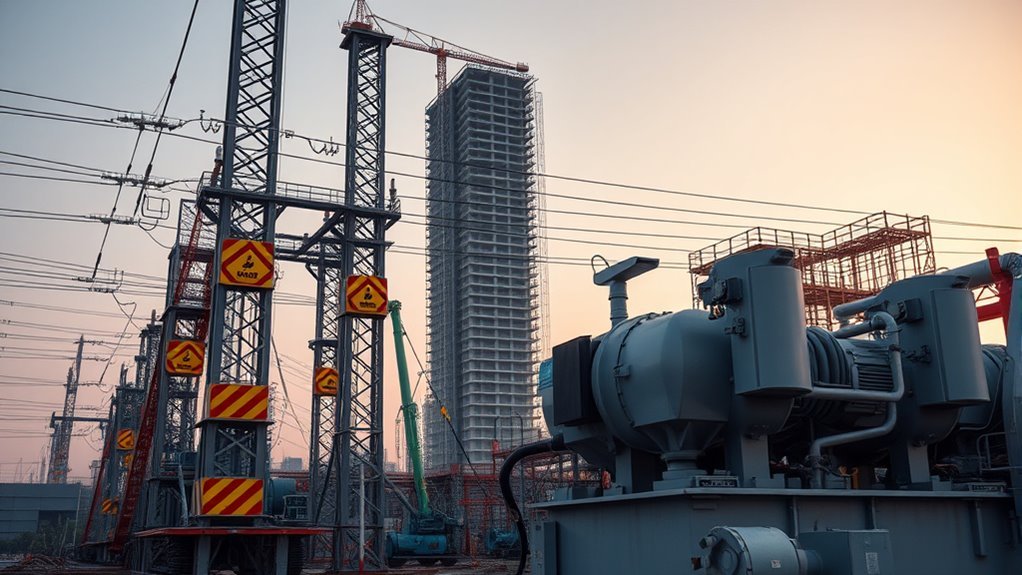
When choosing a power station for construction, we need to take into account the power capacity that matches our workload, along with recharging options that keep us moving efficiently. Flexibility in port selection and the station’s durability also play vital roles in ensuring reliable operation under tough conditions. Additionally, safety certifications and overall construction quality help us select equipment that’s both secure and long-lasting.
Power Capacity Needs
How do we guarantee a power station can handle all the demands of a construction site? We start by calculating the total wattage of all devices and tools that need power at once, ensuring the station’s capacity matches or exceeds that load. It’s essential to account for surge or peak wattage from high-power tools, which can temporarily exceed their normal use. We select a station with a continuous output rating that can handle the combined demand of all equipment. For long-term projects, choosing a station with a large battery capacity (measured in Wh) is crucial to maintain runtime without frequent recharges. Additionally, we consider whether the station supports expandability or extra batteries to accommodate future increases in power needs.
Recharging Speed Options
Have you considered how quickly a power station can recharge during a busy construction day? Faster recharging options like AC wall outlets, solar panels, or hybrid methods allow us to get back to work swiftly. Power stations with rapid recharge capabilities can restore full capacity in under 2 hours, reducing downtime substantially. High-wattage input options, such as 1600W or more, cut recharging times compared to lower wattage inputs. Solar recharging speed depends on panel wattage and weather, which can vary. Hybrid recharging methods, combining AC and solar inputs, offer more efficient and quicker recharges, especially under ideal conditions. Choosing a power station with fast recharging options ensures minimal delays and keeps our construction projects running smoothly.
Port Selection Flexibility
Choosing the right power station means considering its port selection flexibility to meet the diverse needs of construction sites. A versatile station should have multiple output options, like AC outlets, USB-C, USB-A, and DC sockets, so it can power various tools and devices simultaneously. The ability to expand capacity with additional batteries or stacking features allows adaptability for different project sizes. Supporting multiple recharging methods—solar, vehicle, or AC power—assures continuous operation, especially in remote or off-grid locations. Fast recharging, ideally under 2 hours, minimizes downtime between shifts. Additionally, high-wattage support (3600W or more) is essential for heavy-duty equipment. Overall, a flexible port setup guarantees the power station can keep up with the evolving demands of construction work.
Durability and Construction
Durability is a vital factor when selecting a power station for construction sites, as these environments are often tough and unpredictable. We look for models built with rugged materials like magnesium alloy or featuring IP56-rated waterproof designs to withstand harsh conditions. High-quality LiFePO4 batteries are essential, offering over 4,000 charge cycles and stability for continuous use. A sturdy, impact-resistant enclosure protects internal components from physical damage during transportation and heavy-duty tasks. Weather-resistant features, including dust and water resistance, are essential for outdoor environments exposed to the elements. Reinforced ports and connectors also help minimize wear and tear, ensuring the power station remains reliable over time. Ultimately, a well-constructed power station can endure the rigors of construction sites and deliver dependable power when needed most.
Safety and Certifications
When selecting a power station for construction sites, prioritizing safety and certifications is essential to guarantee reliable and secure operation. We check for UL or equivalent safety certifications to ensure the device meets critical safety standards. Built-in protection features like surge, overload, short circuit, and over-temperature safeguards are vital for preventing accidents and equipment damage. A robust Battery Management System (BMS) is crucial for safe battery operation and extending lifespan. For lithium iron phosphate (LiFePO4) batteries, we verify safety certifications, as they’re inherently safer and more stable. Additionally, confirming compliance with local electrical safety regulations and proper labeling ensures safe handling and reduces risks on-site. These steps help us select power stations that are both dependable and safe for construction environments.
Portability and Design
A power station’s design and portability play a significant role in guaranteeing smooth operations on construction sites. A compact, lightweight design makes transportation easier, especially when moving between different areas. Features like pull handles or wheels can greatly enhance mobility for larger units, saving time and effort. A sturdy, durable casing is essential to withstand harsh outdoor conditions and rough handling, assuring longevity and reliability. Modular or expandable designs offer flexibility, allowing customization based on specific power needs and portability requirements. Multiple carrying options, such as shoulder straps or handles, make handling more convenient during busy construction activities. Ultimately, the right balance of portability and thoughtful design ensures that power stations support ongoing work efficiently and safely.
Frequently Asked Questions
How Long Do Portable Power Stations Typically Last on a Construction Site?
Portable power stations usually last between 8 to 12 hours on a construction site, depending on the load and capacity. We recommend monitoring usage and recharging regularly to guarantee continuous power and avoid project delays.
Are These Power Stations Suitable for Outdoor or Harsh Weather Conditions?
We believe these power stations are built to withstand the elements, but don’t throw caution to the wind—always check their specifications for outdoor use, because even the toughest gear needs a little extra TLC in harsh weather.
Can Power Stations Be Integrated With Solar Panels for Renewable Energy?
Yes, power stations can be integrated with solar panels for renewable energy. We often combine solar with traditional power sources, making construction sites more sustainable and reducing reliance on fossil fuels, which benefits the environment and lowers long-term costs.
What Safety Features Are Included in These Portable Power Stations?
Imagine a construction site illuminated by safe, reliable power; these stations feature overload protection, short-circuit safeguards, sturdy enclosures, and automatic shut-offs, ensuring everyone stays safe while we keep your project on track effortlessly.
How Easy Is It to Transport and Set up These Power Stations?
Transporting and setting up these power stations is quite straightforward; we find their lightweight design and user-friendly features make moving them easy, while simple assembly guarantees quick setup, so you’re ready to work without delays.
Conclusion
Choosing the right power station is vital to keep our construction sites running like a well-oiled machine. With options boasting massive capacities and rapid charging, we can tackle any job, anywhere—no matter how wild the terrain. These stations are truly the backbone of modern construction, turning what used to be impossible into everyday reality. Trust us, with the right power station, your project will soar to new heights—faster than you ever thought possible!