Ad Blocker Detected
Our website is made possible by displaying online advertisements to our visitors. Please consider supporting us by disabling your ad blocker.
Some might assume all charging cables serve the same purpose, but in reality, choosing the right type is vital for device safety and efficiency. With a variety of options like USB-A, USB-C, Lightning, and wireless charging, understanding their differences can greatly impact performance. As technology advances, selecting appropriate cables becomes more complex yet essential for reliable portable power solutions. Exploring the nuances can help you optimize your device’s charging experience and avoid common pitfalls.
Key Takeaways
- Portable power banks typically use USB-A or USB-C cables for charging devices on the go.
- Wireless charging options in portable devices offer convenience but often have slower speeds.
- Fast charging protocols like Power Delivery enhance quick recharging of power banks and connected devices.
- Durable, high-quality cables improve safety and longevity during portable power usage.
- Compatibility between cables and devices ensures efficient charging and optimal portable power performance.
Understanding the Different Types of Charging Cables
There are several primary types of charging cables, each designed to suit different devices and use cases. Wired cables like USB-A, USB-C, and Lightning are still prevalent, but advancements have introduced wireless charging options. Wireless charging relies on electromagnetic fields to transfer energy, offering convenience without physical connectors. Fast charging protocols, such as Power Delivery (PD) and Quick Charge, substantially reduce charging times by increasing power output through compatible cables and devices. These cables facilitate rapid energy transfer, essential for modern smartphones and tablets. While wireless charging provides ease of use, it often supports slower charging speeds compared to optimized wired cables. Understanding these types helps us assess their technical capabilities, particularly around compatibility with fast charging and wireless solutions, to meet specific device needs efficiently.
How to Choose the Right Cable for Your Devices
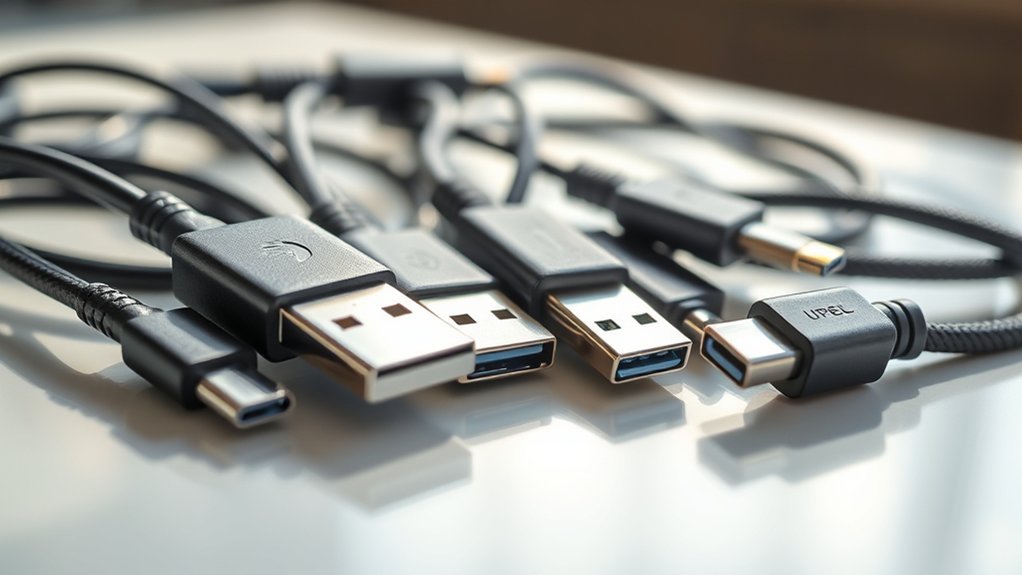
Selecting the appropriate charging cable requires careful assessment of device compatibility, ensuring the connector type and power requirements align. We also consider cable durability factors such as material quality and strain relief to prevent failure over time. Additionally, understanding charging speed implications helps optimize performance without risking damage or inefficiency.
Compatibility With Devices
How can we guarantee we’re choosing a charging cable that seamlessly works with our devices? Compatibility hinges on understanding device specifications, such as wireless charging support and battery capacity. For instance, a device with high battery capacity may require higher wattage cables, while wireless charging compatibility demands specific standards like Qi. To clarify, consider this table:
| Device Feature | Compatible Cable Type | Notes |
|---|---|---|
| Wireless charging support | Qi-compatible cables | Ensures seamless wireless power transfer |
| High battery capacity | Higher wattage, fast-charging cables | Reduces charging time |
| Standard charging needs | USB-C or Lightning cables | Compatibility based on port type |
Matching cable specs to device features ensures efficient, safe charging tailored to your device’s requirements.
Cable Durability Factors
Choosing a durable charging cable requires evaluating key material and construction factors that influence longevity and performance. Cable insulation plays an essential role by protecting internal conductors from mechanical stress, moisture, and chemical exposure, reducing the risk of failure over time. High-quality insulation materials, such as thermoplastic elastomers or rubber, offer enhanced flexibility and resistance to wear. Additionally, connector corrosion greatly impacts durability; corrosion at contact points impairs electrical conductivity and can lead to intermittent charging or complete failure. Robust connectors with protective coatings or gold-plated contacts resist oxidation, extending their lifespan. By analyzing these factors—insulation resilience and corrosion resistance—we can select cables optimized for durability, ensuring consistent performance and reducing replacement frequency.
Charging Speed Considerations
Ever wondered why some charging cables deliver rapid power transfer while others slow down your device? The key lies in the cable’s specifications and compatibility with fast charge protocols. High-quality cables supporting fast charge standards, such as USB Power Delivery, enable higher current flows, reducing charging time. Wireless charging, while convenient, often has limitations in speed, depending on coil alignment and wattage capacity. When choosing a cable, consider the device’s maximum charging rate—using a cable that cannot handle the required power results in slower charging or no improvement at all. Shorter cables with thicker wiring typically support higher speeds. Ultimately, selecting a cable aligned with your device’s fast charge capabilities and ensuring compatibility with wireless charging can optimize your charging efficiency.
Comparing USB-A, USB-C, and Lightning Cables
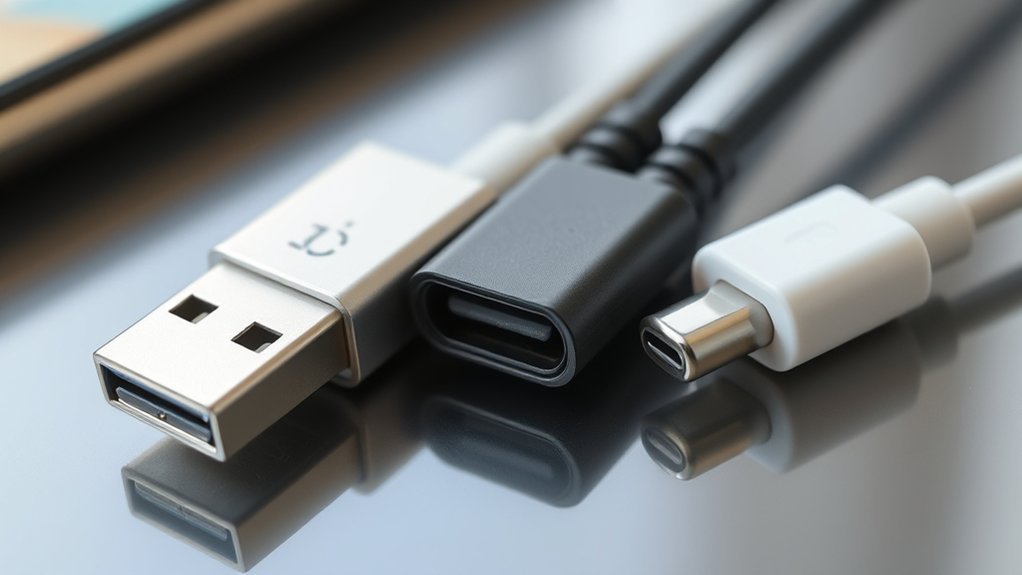
While all three cable types—USB-A, USB-C, and Lightning—serve the fundamental purpose of data transfer and charging, they differ markedly in design, capabilities, and compatibility. USB-A cables feature a bulky, rectangular connector with widespread compatibility, but their outdated design impacts cable aesthetics and limits efficiency. USB-C cables are more streamlined, offering reversible connectors, higher data transfer rates, and increased power delivery, making them versatile for modern devices. Lightning cables, proprietary to Apple, provide compactness and reliable performance but lack universal compatibility, raising environmental concerns due to frequent replacements. The environmental impact of these cables varies; USB-C’s durability and widespread adoption can reduce waste, whereas proprietary Lightning cables may contribute to e-waste. Overall, each type reflects a different approach to balancing functionality, aesthetics, and environmental considerations.
Proprietary vs. Universal Charging Cables: Pros and Cons
Proprietary and universal cables present different trade-offs regarding compatibility, cost, and device safety. Proprietary cables often guarantee optimized performance but can lead to higher expenses and limited device interoperability, while universal cables offer broader compatibility but may compromise safety or charging efficiency. Analyzing these factors helps us understand the impact on both user convenience and device longevity.
Compatibility Challenges
The debate between proprietary and universal charging cables centers on compatibility challenges that directly impact user convenience and device interoperability. Proprietary cables often optimize for specific features like wireless charging or high battery capacity, but limit compatibility with other devices. Conversely, universal cables promote broad compatibility but may lack optimized data transfer or fast-charging capabilities. The table below illustrates these differences:
| Feature | Proprietary Cables | Universal Cables |
|---|---|---|
| Compatibility | Limited to specific brands | Broad, multi-brand use |
| Wireless Charging | Often optimized | Varies, less optimized |
| Battery Capacity | Supports high capacity | May be limited |
| Data Transfer | Faster, brand-specific | Slower, standardized |
| Future Compatibility | Less adaptable | More adaptable |
This disparity influences device interoperability, especially with emerging wireless charging standards and increasing battery capacities.
Cost Implications
Cost implications are a critical factor in choosing between proprietary and universal charging cables, as they directly influence both initial expenditure and long-term expenses. A thorough cost comparison reveals that proprietary cables often carry higher upfront costs due to brand reputation and specialized design, but may reduce long-term replacement needs if optimized for specific devices. Conversely, universal cables tend to be more affordable initially and generally offer broad compatibility, but can incur additional costs over time if lower quality or incompatible options lead to frequent replacements or accessories. The decision hinges on balancing the premium associated with proprietary brands against the flexibility and cost savings of universal options. Ultimately, understanding these cost dynamics helps consumers make informed choices aligned with their budget and device ecosystem.
Device Safety
While compatibility is often prioritized, device safety remains a critical factor when choosing between proprietary and universal charging cables. Proprietary cables typically feature tailored safety mechanisms, such as built-in voltage regulation, reducing risks of overcurrent or overheating, especially with wireless charging setups. Conversely, universal cables may lack these safeguards, increasing potential damage. Consider these points:
- Proprietary cables often include optimized circuitry for specific devices, enhancing safety.
- Universal cables may pose compatibility issues, risking voltage mismatches.
- Solar powered cables and wireless charging devices require specialized safety features to prevent damage.
- The quality and certification of universal cables vary, impacting their safety standards.
Selecting high-quality, certified proprietary options ensures device integrity, while universal cables demand thorough safety evaluation to mitigate risks.
Tips for Maintaining and Extending Your Cable Lifespan
Maintaining and extending the lifespan of your charging cables requires deliberate care to prevent common sources of damage. Proper cable storage minimizes strain on internal wires, reducing breakage risk. Avoid tight coils; instead, loosely loop cables and secure them with Velcro straps. Regular inspection for wear and tear enables early DIY repairs, such as replacing frayed connectors or damaged shielding. Proper handling during use—avoiding excessive bending or pulling—preserves internal integrity. Implementing these practices enhances longevity and ensures reliable performance.
| Practice | Benefit | Implementation |
|---|---|---|
| Cable storage | Prevents internal wire stress | Loosely coil, secure with straps |
| Visual inspection | Early damage detection | Check for frays or exposed wires |
| DIY repairs | Extends cable usability | Replace connectors or shielding |
The Future of Charging Cables: Trends to Watch
As technology advances, the design and functionality of charging cables are evolving rapidly to meet increasing demands for speed, durability, and convenience. Future trends include:
- Wireless charging integration, reducing physical connectors and enabling seamless device power-up.
- Solar-powered cables, harnessing renewable energy for eco-friendly off-grid charging.
- Enhanced durability with materials designed for extreme conditions, extending cable lifespan.
- Universal compatibility through standardized connectors like USB-C, simplifying multi-device charging.
These developments aim to optimize efficiency while minimizing environmental impact. Wireless charging eliminates cable clutter, but innovations like solar-powered cables push sustainability boundaries. As these trends mature, we can expect smarter, more versatile solutions that prioritize both user convenience and ecological responsibility.
Troubleshooting Common Charging Cable Issues
Charging cable issues are a common source of user frustration, often stemming from hardware degradation, connection defects, or compatibility problems. Poor contact or frayed wires can hinder data transfer or power delivery, impacting wireless charging efficiency and battery health. To troubleshoot, check cable integrity, guarantee secure connections, and verify device compatibility. Sometimes, replacing worn-out cables resolves these issues. Consider the following factors:
| Issue | Solution |
|---|---|
| Hardware degradation | Replace cable or repair connections |
| Connection defects | Clean contacts or try different ports |
| Compatibility with wireless charging | Use certified cables/devices |
Understanding these factors helps optimize charging performance, preserving battery health and ensuring reliable wireless charging.
Frequently Asked Questions
Are There Eco-Friendly Charging Cable Options Available?
Yes, we find eco-friendly charging cables made from sustainable materials like recycled plastics and biodegradable compounds, manufactured through sustainable processes. These options reduce environmental impact while maintaining durability and performance, aligning with eco-conscious technology trends.
How Do Charging Cables Impact Device Charging Speed?
Charging cables drastically impact device charging speed through cable compatibility and support for fast charging protocols, which considerably optimize current flow. Properly matched cables prevent bottlenecks, ensuring rapid, efficient charging that’s vital for high-performance device functionality.
Can Counterfeit Cables Damage My Devices?
Counterfeit cables pose significant risks to our devices due to poor cable durability, which can lead to overheating, short circuits, or permanent damage. We must recognize counterfeit risks and prioritize authentic, certified cables for safe, reliable charging performance.
Are There Wireless Charging Cable Alternatives?
Wireless charging offers a groundbreaking alternative to traditional cables, eliminating cable durability concerns while providing seamless power transfer. This technology’s efficiency and convenience dramatically enhance device longevity and user experience, making it a game-changing solution in portable power management.
What Safety Standards Should I Look for in Cables?
We look for cables meeting strict safety standards, emphasizing durability and compatibility standards. Ensuring the cable’s materials resist wear and conform to recognized certifications helps prevent accidents, protecting both users and devices from electrical hazards and failures.
Conclusion
In summary, understanding the variety of charging cables is essential for optimizing device performance and safety. With over 50 billion USB devices in use globally, selecting the right cable type can significantly impact charging efficiency and device longevity. As technology advances, trends like higher power delivery and universal standards will shape future options. Staying informed and maintaining cables properly ensures reliable portable power, enabling us to meet the increasing demand for fast, safe, and versatile energy transfer.