Ad Blocker Detected
Our website is made possible by displaying online advertisements to our visitors. Please consider supporting us by disabling your ad blocker.
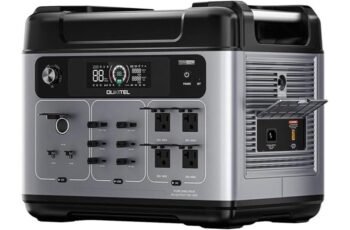
We find the PowerMax 6000 combines 6,000W continuous output, 9,000W peak power, and 120/240V split-phase supply with a 3,600Wh LiFePO4 battery. It can run demanding equipment, while expandable storage supports longer backup needs. AC charging takes about 1.96 hours, and solar or vehicle charging adds flexibility, though solar results depend on conditions. At 101 pounds, it’s difficult to move, and its price and four outlets may not suit every household. We’ll examine its features, trade-offs, and best-fit uses.
Key Takeaways
- The PowerMax 6000 delivers 6,000W continuous output, 9,000W peak power, and 120/240V split-phase electricity for demanding equipment.
- Its 3,600Wh LiFePO4 battery supports home backup and off-grid use, with expandable capacity up to 57.6kWh.
- Charging options include AC, solar, and a vehicle outlet; AC charging takes about 1.96 hours.
- App monitoring, a roughly 0.01-second UPS switch, and a five-year warranty add convenience and protection.
- At 101 pounds, it is difficult to move, and its four outlets, base capacity, and high upfront cost may not suit everyone.
6,000W Power On the Go
With 6,000W of continuous output and 9,000W peak power, the PowerMax 6000 can run demanding appliances such as power tools, air conditioners, and water pumps. Its 120/240V split-phase output supports household equipment, while a 3,600Wh LiFePO4 battery stores energy for use away from the grid.
We can pair the unit with its three 200W solar panels to replenish stored electricity using sunlight, reducing reliance on fuel-powered generators when conditions allow. For camping, RV trips, outdoor events, or home backup, this portable power system provides mobile electricity for varied loads. Its expandable capacity can reach 57.6kWh for longer-term energy needs.
Detailed features
Beyond its output capacity, the PowerMax 6000 combines fast charging, app-based monitoring, and backup protection. AC charging takes about 1.96 hours, while compatible solar panels or a vehicle outlet provide charging flexibility for different settings.
App connectivity via Wi-Fi or Bluetooth lets us check battery status, control connected devices, adjust charging speed, and review energy use. Its built-in UPS switches to battery power in approximately 0.01 seconds during an outage, supporting sensitive equipment.
A surge protector helps guard against voltage spikes. The LiFePO4 battery management system monitors charging and operating conditions, helping protect the battery and support long-term use with renewable energy.
Pros and Cons
We’ll weigh the PowerMax 6000’s high output, expandable LiFePO4 storage, and solar charging against its 101-pound weight and four outlets.
These trade-offs matter when you’re choosing a lower-emission backup or off-grid power system. Let’s examine the main pros and cons.
Pros
The PowerMax 6000’s main advantages are its high output, durable LiFePO4 battery, and flexible charging options. Its 6,000W continuous output, 9,000W peak capacity, and 120/240V split-phase supply can support demanding appliances and tools.
We can expand its 3,600Wh capacity to 57.6kWh for extended backup. Long cycle life—up to 3,500 charge cycles—supports sustained use, while the battery management system helps protect cells.
AC charging takes about 1.96 hours, and compatible solar panels or a vehicle outlet provide alternatives. App monitoring lets us check status, control devices, adjust charging, and review energy use over Wi-Fi or Bluetooth.
Cons
Despite its high output, the PowerMax 6000 has trade-offs: at 101 pounds, it’s difficult to move, and its 3,600Wh battery may not cover prolonged outages without expansion or recharging. We’d treat heavy portability as a practical limitation for camping or frequent relocation; its dimensions also require substantial storage space.
High upfront cost may deter buyers who need only modest backup capacity, although the expandable battery and long cycle rating could support years of use. Solar charging reduces reliance on grid electricity, but output depends on sunlight and compatible panels. We’d assess your energy needs, transport options, and budget before choosing this system.
Concluding thoughts
For users who need substantial backup capacity, the PowerMax 6000 combines a 3,600Wh LiFePO4 battery, 6,000W output, and solar charging in a system that can expand to 57.6kWh. We’d consider its 3,500-cycle battery rating, five-year warranty, and app monitoring when evaluating long term value.
Ideal users include households preparing for outages, RV travelers, and off-grid operators who can make use of its split-phase output and expandable storage. At 101 pounds, it’s less convenient to move than smaller stations.
Solar charging can reduce reliance on grid electricity, though actual results depend on panel conditions and energy demand. We’d match capacity to your needs.
Frequently Asked Questions
How Many Packages Should I Expect for the Power Station and Solar Panels?
We should expect two packages: one containing the PowerMax 6000 power station and another containing the solar panels. Package delivery may be staggered, so our Box count is two, though arrivals might differ.
What Are the Powermax 6000’s Dimensions and Weight?
Dimensions and Weight: The PowerMax 6000 measures 13.8 × 17.5 × 23.2 inches and weighs 101 pounds. Portability Considerations: We can appreciate its compact footprint, though we wouldn’t mistake this battery for featherweight camping gear.
Which Company Manufactures the Powermax 6000?
Shenzhen Doke Communication Co., Ltd. manufactures the PowerMax 6000. For Manufacturer background and Brand ownership details, we can confirm only the listed manufacturer; the provided specifications don’t identify a separate brand owner or describe the company’s sustainability practices.
Does the Companion App Support Multiple Languages?
Yes, the companion app supports multiple languages. Think of it as a multilingual control room: we can check its App language options and Multilingual interface while monitoring energy use, helping us manage stored power thoughtfully.
What Devices Can the Built-In UPS Support During a Brief Outage?
We can use the built-in UPS to support computers, servers, refrigerators, and aquarium pumps during brief outages. Its approximately 0.01-second transfer helps protect essential devices; check UPS backup limits against each device’s power requirements.
Conclusion
The PowerMax 6000 brings substantial, flexible power to outages, off-grid stays, and demanding equipment, while its LiFePO4 battery and included solar panels offer a more renewable charging option. We appreciate its split-phase output and broad charging choices, but its 101-pound weight, separate-package shipping, and 3,600Wh capacity deserve careful consideration. Before buying, we’d match its runtime and recharge rate to our needs. For serious backup power, it’s a capable, but not effortless, companion.