Ad Blocker Detected
Our website is made possible by displaying online advertisements to our visitors. Please consider supporting us by disabling your ad blocker.
At first glance, choosing between a portable power station and a power bank may seem straightforward, but the differences run deeper than size alone. These devices serve distinct purposes, with varying capacities, power outputs, and design features that can considerably impact their effectiveness for your needs. Understanding which option aligns with your specific usage scenarios requires careful analysis of their technical characteristics and practical applications, making it essential to explore their defining features before making a decision.
Key Takeaways
- Power stations are larger, heavier, and suited for high-capacity, heavy-duty applications; power banks are compact and portable for quick device charging.
- Power stations support multiple outlets and higher wattages; power banks mainly charge smartphones and small gadgets via USB.
- Power stations often include solar input and are designed for off-grid, long-term use; power banks are for short-term, on-the-go charging.
- Power stations have higher upfront costs, longer lifespan, and durability; power banks are cheaper but have shorter battery cycles.
- Proper device and power requirement matching is essential; choosing incorrectly can cause inefficiency or damage.
What Are Portable Power Stations and Power Banks?
While both portable power stations and power banks serve the purpose of providing portable energy, they differ markedly in design and capacity. Portable power stations are substantial, often featuring AC outlets, multiple USB ports, and advanced features like wireless charging and solar compatibility. They are engineered for high-capacity energy storage, making them suitable for powering larger devices or multiple gadgets simultaneously. Power banks, in contrast, are compact, primarily designed for quick, on-the-go charging of smartphones and small devices, usually via USB. They typically lack the advanced functionalities of power stations, such as AC outputs or solar compatibility. Power banks often incorporate wireless charging pads for convenience, but their capacity remains limited compared to larger, feature-rich portable power stations.
Key Differences in Size, Power Output, and Capacity
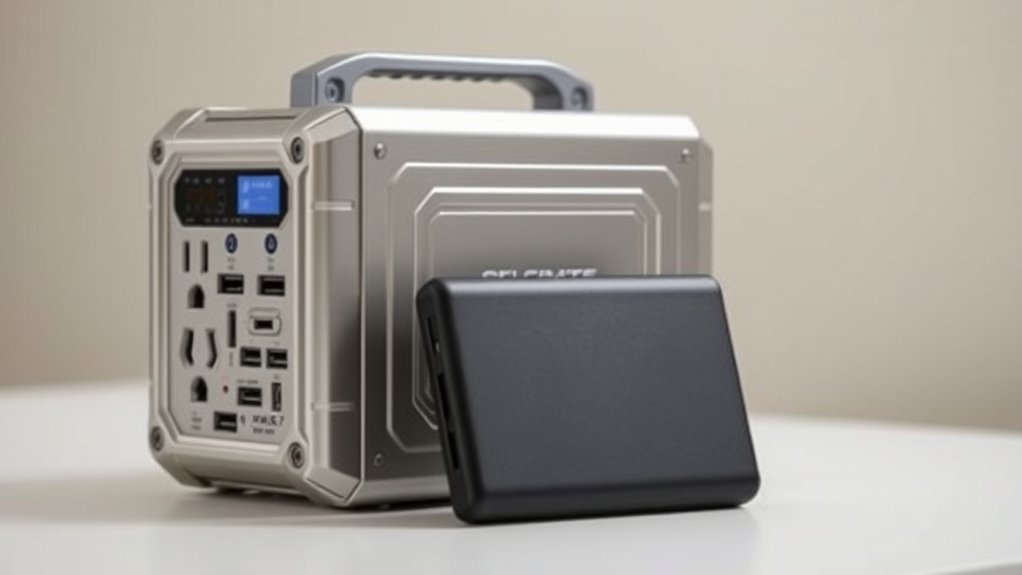
We examine how size and portability influence practical use, noting that power stations are considerably bulkier than power banks. The differences in power output and capacity directly affect their suitability for various applications, with power stations delivering higher wattage and longer runtimes. Understanding these distinctions enables informed decisions based on device requirements and logistical constraints.
Size and Portability
Size and portability are primary factors distinguishing portable power stations from power banks, as they directly influence usability and convenience. Power stations are considerably larger due to advanced battery technology, which enables higher capacity and diverse power outputs, often including AC outlets. Their size facilitates integration of multiple charging options and solar compatibility, supporting renewable energy inputs for extended use. Conversely, power banks are compact and lightweight, optimized for portability with minimal bulk, suitable for quick charges on the go. While power banks prioritize ease of transport, their limited capacity constrains prolonged use. The substantial size difference reflects their respective design intents: power stations for heavy-duty, extended applications, and power banks for lightweight, immediate needs.
Power and Capacity
The core distinction between portable power stations and power banks lies in their power output and capacity, which directly impact their performance and application. Power stations utilize advanced battery technology, often lithium-ion or lithium-polymer, enabling higher capacity and sustained energy delivery. This results in substantial power output, suitable for charging larger devices or multiple appliances simultaneously. Power banks, by contrast, typically have lower capacity and are optimized for energy efficiency in small-scale charging, such as smartphones or tablets. The differences in size reflect these capabilities—power stations are larger but deliver higher wattages, while power banks prioritize portability. Ultimately, these variations in battery technology, energy efficiency, and capacity determine their suitability for different needs, from emergency backup to outdoor power solutions.
When to Use a Portable Power Station vs a Power Bank?
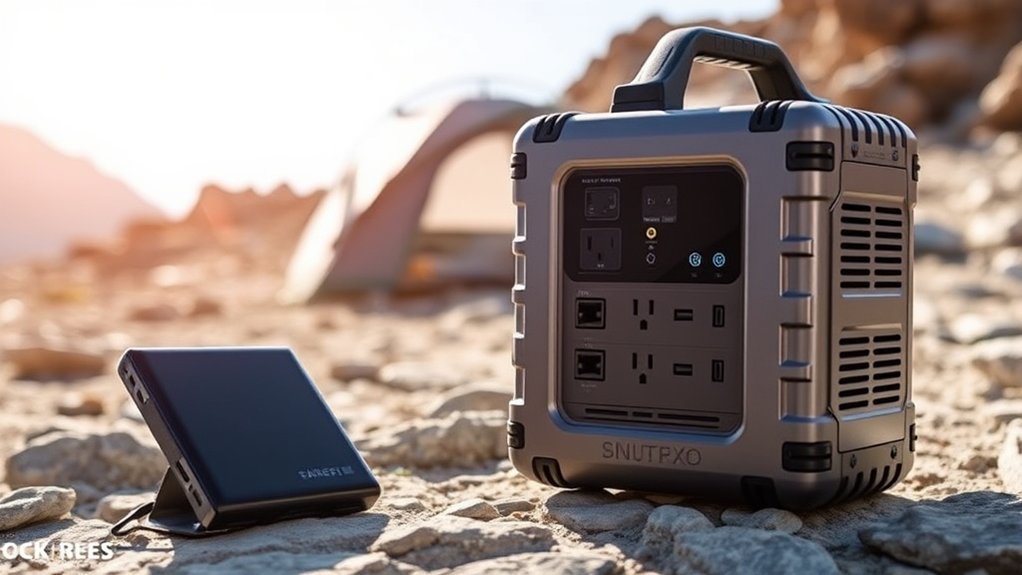
Understanding the ideal scenarios for utilizing a portable power station versus a power bank hinges on evaluating the power requirements, duration, and portability needs of your devices. Portable power stations are suitable for high-demand appliances and prolonged use, where battery efficiency and capacity are critical for sustained operation. They also tend to have a lower environmental impact due to larger, more efficient batteries and potential for renewable energy integration. Conversely, power banks excel for short-term, low-power tasks such as charging smartphones or tablets on the go. They offer superior portability and quick access, but their smaller capacity limits extended use. Selecting the appropriate device depends on analyzing these factors—power demands, environmental considerations, and operational duration—to guarantee efficient and environmentally conscious energy management.
Charging Capabilities and Types of Devices Supported
We’ll examine how the variety of charging ports, supported device types, and power output options influence the suitability of portable power stations and power banks. Understanding these technical specifications helps determine which device can meet specific power needs efficiently. This comparison provides clarity on compatibility and performance for different use cases.
Charging Ports Variety
Charging ports vary considerably between portable power stations and power banks, directly impacting their versatility in supporting different devices. Power stations often feature a diverse array of ports, including AC outlets, USB-C, USB-A, and DC outputs, enabling simultaneous charging of multiple device types with varying power requirements. This diversity enhances solar compatibility, allowing direct solar input through dedicated ports for efficient recharging. In contrast, power banks typically offer fewer ports, mostly USB-A and USB-C, limiting device support but providing rapid charging speeds for smartphones and tablets. The variety of ports directly influences charging speed and device compatibility, with power stations generally supporting higher wattage outputs for larger gadgets. This technical differentiation underscores the importance of port selection based on specific device needs and recharging preferences.
Supported Device Types
What types of devices can portable power stations and power banks support, and how do their charging capabilities differ? Power banks typically support smartphones, tablets, and small gadgets via USB, often including wireless charging for compatible devices. Portable power stations accommodate larger devices like laptops, cameras, and small appliances through AC outlets, DC ports, and USB options. Their higher capacity supports renewable energy integrations, enabling off-grid charging.
| Device Type | Power Bank Support | Power Station Support |
|---|---|---|
| Smartphones & Tablets | USB, Wireless charging | USB, Wireless charging |
| Laptops | Limited, via USB-C or AC adapters | Full support with AC outlets |
| Small Appliances | Not supported | Supported via AC/DC ports |
| Renewable Energy | Minimal, mainly USB charging | Supports solar/inverter input |
Power Output Options
How do the power output options of portable power stations and power banks influence their ability to support various devices? These options determine compatibility, energy efficiency, and environmental impact. Portable power stations typically feature AC outlets, USB-C, USB-A, and DC outputs, supporting a wider range of devices with higher power demands. Power banks generally rely on USB ports, limiting their support to smaller gadgets. The diversity of output types affects energy efficiency by reducing conversion losses and optimizing device performance. Additionally, the power station’s higher wattage output results in a lower environmental impact per use due to fewer recharges.
- AC outlets for larger appliances
- USB-C PD for fast charging
- Multiple USB-A ports
- DC barrel connectors
- Wattage and voltage regulation
Design and Portability: Which Fits Your Lifestyle?
While both portable power stations and power banks prioritize mobility, their design and portability features considerably differ, influencing their suitability for various lifestyles. Power banks are compact, lightweight devices utilizing lithium-ion or lithium-polymer battery technology, making them highly portable for everyday use. In contrast, portable power stations are larger, featuring heavier batteries often based on lithium iron phosphate or lithium nickel manganese cobalt oxide, which provide higher capacity and power output but increase size and weight. Design considerations also include ease of transport and environmental impact; power banks generally have a lower environmental footprint due to smaller batteries and simpler manufacturing processes. Portable power stations, while more resource-intensive, offer enhanced functionality for outdoor or emergency scenarios. Ultimately, choice depends on balancing portability needs with environmental considerations and power capacity requirements.
Cost, Battery Life, and Durability Considerations
Although portable power stations typically have higher upfront costs, they often deliver superior durability and longer battery life compared to power banks. A detailed cost analysis reveals that initial investment is offset by extended operational lifespan and reduced replacement frequency. Durability factors include robust casing, thermal management, and high-quality internal components, which enhance device longevity. Key considerations include:
- Higher initial purchase price
- Extended cycle life and recharge capacity
- Resistance to environmental stressors
- Advanced battery technology (e.g., lithium-ion, lithium-polymer)
- Lower total cost of ownership over time
These aspects underscore that while the upfront expense is greater, the long-term benefits—such as improved durability and battery endurance—favor portable power stations for demanding applications.
How to Choose the Right Device for Your Needs
Selecting the appropriate power device depends on a clear assessment of your specific energy needs, usage environment, and portability requirements. For high-demand or extended use, a portable power station offers higher capacity, multiple outlets, and eco-friendly options like solar charging, making it suitable for outdoor or emergency scenarios. Conversely, power banks are ideal for lightweight, short-term use, such as charging smartphones or tablets on the go. Consider environmental preferences too—solar charging capabilities in power stations promote sustainability, reducing reliance on grid power. Evaluate whether portability or capacity outweighs convenience. If you prioritize eco-friendly options and longer-lasting power, a portable station is ideal. For quick, portable, and less demanding tasks, a power bank suffices. Matching device features to your specific needs ensures efficient, reliable energy provision.
Common Mistakes to Avoid When Picking a Power Source
One common mistake is focusing solely on capacity without considering the device’s power output and compatibility. Ignoring these factors can lead to inefficient energy transfer or device damage. When selecting a power source, assess the device’s wattage requirements, guaranteeing the power station or power bank can meet peak loads. Solar compatibility is critical for off-grid use and emergency preparedness; verify whether the device supports solar charging and its efficiency. Additionally, consider the device’s output ports, voltage stability, and whether it can handle sensitive electronics. Failing to evaluate these technical specifications risks underperformance or incompatibility in critical situations. Properly matching capacity, output, and compatibility ensures reliable operation, especially in emergency scenarios or when integrating with renewable energy sources.
Frequently Asked Questions
Can Portable Power Stations Charge Multiple Devices Simultaneously?
Yes, portable power stations can charge multiple devices simultaneously, leveraging their large battery capacity and multiple output ports. This allows for efficient charging, though charging speed may vary depending on the device’s power requirements and station’s output capabilities.
Are Power Banks Suitable for Outdoor Camping or Hiking?
Power banks are surprisingly suitable for outdoor camping or hiking, thanks to their ample battery capacity and rapid charging speeds. We find they efficiently keep devices powered, ensuring connectivity and safety even in remote locations, making them essential portable tools.
How Long Do Portable Power Stations Typically Last on a Single Charge?
Portable power stations typically last through 500 to 1,000 charging cycles, translating to several years of reliable use. Their battery lifespan depends on usage patterns, but proper maintenance can extend their operational longevity considerably.
Do Power Banks Support Fast Charging for Smartphones?
Power banks support fast charging for smartphones, depending on their battery capacity and charging speed specifications. Higher-capacity models with advanced charging technology enable quicker power transfer, optimizing device recharge times efficiently and precisely.
Are There Environmental Impacts Associated With Using Portable Power Stations?
Environmental impacts of portable power stations hinge on their energy source; renewable energy reduces carbon footprint, making them more sustainable. Yet, manufacturing and disposal still pose challenges, requiring careful lifecycle management to minimize ecological harm.
Conclusion
Ultimately, choosing between a portable power station and a power bank is like selecting the right tool for a specific mission—each has its unique strength. Understanding their technical differences guarantees we’re not just plugging in blindly but strategically powering our lives. By aligning device capacity, portability, and intended use, we avoid the trap of superficiality. With precise knowledge, we can navigate the energy landscape confidently, guaranteeing our power solutions are as reliable as a well-engineered compass guiding us through any scenario.