Ad Blocker Detected
Our website is made possible by displaying online advertisements to our visitors. Please consider supporting us by disabling your ad blocker.
Understanding the capacity of a portable power station is essential for ensuring reliable energy supply in critical situations or off-grid applications. With diverse sizes and performance metrics available, selecting the right device requires careful analysis of your specific power needs. We’ll explore how watt-hours influence runtime, compare various capacities, and examine emerging technological trends—all vital for making an informed decision that balances performance, portability, and longevity. The key to optimizing your energy setup begins here.
Key Takeaways
- Understand that watt-hour (Wh) ratings indicate device runtime and charging speed, influencing overall performance.
- Match power station capacity to your device power needs and usage scenarios for optimal efficiency.
- Consider size categories (small, medium, large) to balance portability, capacity, and durability.
- Evaluate peak power draw capacity to ensure it handles surges and prevents overloads.
- Stay informed on technological advancements like higher energy densities and smart management for future-proof choices.
What Is Portable Power Station Capacity and Why Does It Matter?
Have you ever wondered how portable power stations manage to supply energy to your devices? Their capacity is a critical factor, reflecting the total energy storage, typically measured in watt-hours (Wh). This capacity determines how long your devices can run before recharging. Battery longevity plays a key role here, as higher-quality batteries maintain capacity over many charge cycles, ensuring consistent power output. Charging efficiency also influences practical capacity; efficient charging minimizes energy loss, maximizing usable power. Understanding capacity helps you evaluate a station’s ability to support your needs, whether for camping or emergency backup. The balance between battery longevity and charging efficiency ultimately impacts the station’s reliability, lifespan, and overall value, making capacity a fundamental aspect of portable power station performance.
How to Understand Watt-Hours and What They Tell You
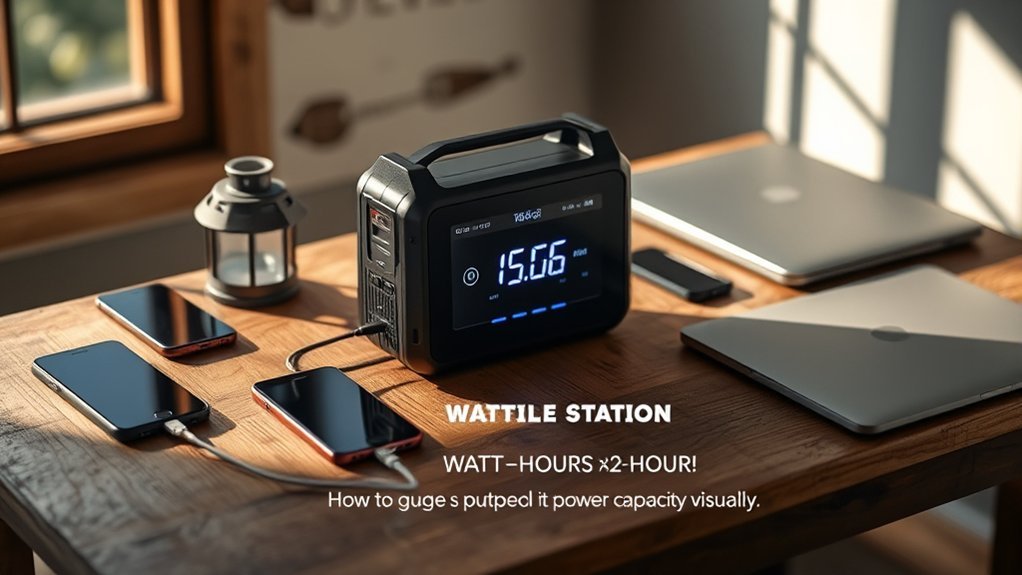
Understanding watt-hours (Wh) is essential for accurately evaluating a portable power station’s capacity because it quantifies the total energy stored within the device. Wh reflects how much power a station can deliver over time, directly impacting energy efficiency and charging speed. To interpret Wh effectively, consider the following:
| Capacity (Wh) | Runtime for 10W device | Energy Efficiency Impact |
|---|---|---|
| 200 Wh | 20 hours | Higher Wh means longer use |
| 500 Wh | 50 hours | Faster charging possible |
| 1000 Wh | 100 hours | Better for high-demand devices |
A higher Wh rating indicates more stored energy, but efficiency and charging speed also influence practical performance. Understanding these factors helps optimize usage based on your needs.
Comparing Power Station Sizes: Small, Medium, and Large Capacities
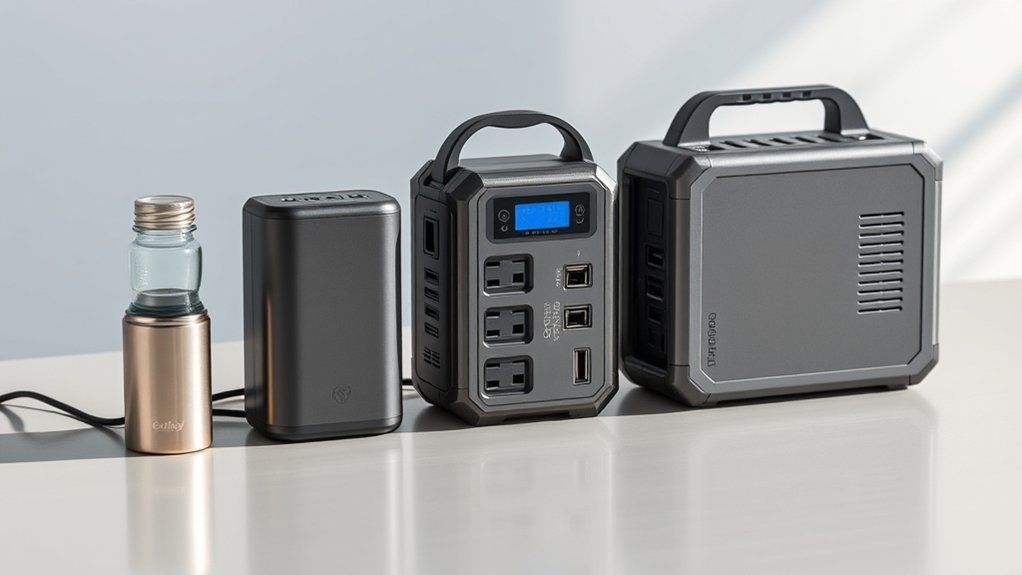
When comparing power station sizes, it’s important to recognize that capacity categories—small, medium, and large—directly influence their suitability for various applications. Small units typically offer limited capacity, prioritizing portability and quick recharge cycles, which can enhance battery longevity under light use. Medium capacities balance portability with increased runtime, making them versatile for outdoor activities and emergency backup. Large stations provide extensive capacity, ideal for prolonged power needs, but may reduce battery longevity over time due to higher charge cycles. Solar compatibility varies across sizes; smaller units often feature basic solar input, while larger stations tend to support higher wattage solar panels, improving recharging efficiency. Understanding these distinctions helps in selecting a power station aligned with your specific energy demands and long-term reliability.
Choosing the Right Capacity for Your Devices and Use Cases
To select the appropriate capacity, we must first analyze the power requirements of your devices and the expected usage scenarios. Understanding the energy consumption patterns allows us to match power station specifications with operational needs effectively. This approach guarantees ideal performance and avoids under- or overestimating your power needs.
Device Power Requirements
How do we determine the appropriate capacity for a portable power station to meet our device demands? We start by calculating the total watt-hour requirements of our devices, considering their power consumption and usage duration. It’s crucial to account for battery lifespan, as higher-capacity units may extend overall longevity but could impact charging efficiency. Understanding each device’s peak power draw ensures the station can handle surges without failure. Additionally, we evaluate the charging efficiency—how effectively the station replenishes its energy—since losses during charging affect available capacity. By analyzing these factors, we select a power station that balances capacity with durability, guaranteeing reliable operation while optimizing battery lifespan and maintaining efficient recharging cycles.
Typical Usage Scenarios
Selecting the appropriate capacity for a portable power station hinges on analyzing typical usage scenarios and understanding the specific energy demands of your devices. For instance, camping trips often require lightweight units capable of powering essential electronics, while emergency backup needs demand higher capacity for sustained power. Key scenarios include:
- Powering small appliances during camping trips
- Charging smartphones and tablets in emergencies
- Running LED lights during outdoor activities
- Supporting medical devices in power outages
- Operating small refrigerators or fans during emergencies
How Battery Chemistry Affects Power Station Performance
Battery chemistry directly influences the performance characteristics of portable power stations by determining energy density, charge cycles, and safety profiles. Lithium-ion chemistries, for example, offer high energy density and robust chemical longevity, making them ideal for sustained use. Conversely, nickel-based chemistries tend to have lower energy density but can provide increased battery stability under specific conditions. The choice of chemistry impacts safety; some chemistries are more prone to thermal runaway, affecting overall reliability. Battery stability is vital for long-term performance, reducing degradation and maintaining capacity over multiple cycles. Understanding these chemical properties helps us gauge a power station’s longevity and performance consistency, ensuring we select a model that aligns with our operational demands and safety standards.
Practical Tips for Estimating Your Power Needs
Estimating your power needs accurately is fundamental to choosing a portable power station that meets your operational demands. Proper assessment guarantees ideal battery lifespan and efficient charging speed, preventing premature degradation or insufficient power delivery. To determine capacity, consider the total watt-hours (Wh) of devices you’ll run, factoring in startup surges. Analyze continuous power consumption to avoid overloads. Prioritize devices with high energy demands, and account for future expansion. Recognize that higher capacity stations typically offer better battery lifespan through optimized charge cycles. Additionally, evaluate charging speed for quick turnaround times.
- Calculate total watt-hours required based on device specifications
- Include surge wattage for devices with high startup loads
- Assess daily energy consumption to determine capacity needs
- Factor in potential future device additions
- Consider charging speed to minimize downtime
Common Mistakes When Selecting a Portable Power Station Capacity
One common mistake is underestimating the actual power demands of devices, which can lead to choosing a station with insufficient capacity. However, overcapacity pitfalls also exist, as some buyers fall into the trap of capacity inflation—selecting units far larger than necessary. This inflated capacity increases costs and reduces portability without tangible benefits. Overestimating needs may seem safe but often results in unnecessary bulk and energy inefficiency, while the excess capacity remains underutilized. Accurate assessment of power requirements is essential to avoid these errors. We recommend calculating peak loads and considering future expansion, but avoid the temptation of over-specification driven by assumptions of future needs. Striking the right balance prevents both underperformance and unnecessary expense rooted in capacity inflation.
Future Trends in Power Station Capacity and Technology
Advancements in power station capacity and technology are shaping a future where portable energy solutions become more efficient, scalable, and adaptable. Innovations focus on integrating renewable energy sources, enhancing grid independence, and increasing capacity density. Emerging trends include the deployment of hybrid systems combining solar, wind, and battery storage for superior efficiency. Battery technologies are advancing toward higher energy densities and faster charging, supporting longer use and quicker replenishment. Smart management systems enable real-time power distribution, improving reliability and scalability. Additionally, modular designs facilitate easy upgrades and customization for diverse applications. These developments aim to support remote operations, disaster resilience, and off-grid living, all while reducing environmental impact and expanding the usability of portable power stations in various sectors.
- Renewable integration for cleaner energy
- Enhanced grid independence capabilities
- Increased capacity density and modular design
- Smart, adaptive power management systems
- Faster charging and longer lifespan technologies
Frequently Asked Questions
How Long Can a Portable Power Station Run Specific Devices?
We analyze battery life and energy consumption to estimate device runtime; typically, a portable power station runs a device for several hours, depending on its power draw, with larger capacities providing extended operation durations for specific devices.
What Are the Best Brands Offering High-Capacity Power Stations?
We recommend brands like Goal Zero, Jackery, and EcoFlow for high-capacity power stations, as they excel in battery longevity and portability features, ensuring reliable performance and ease of transport during extended outdoor or emergency use.
How Does Weather Impact a Power Station’s Performance?
Weather substantially impacts a power station’s performance, affecting climate resilience and power efficiency; extreme temperatures can reduce battery capacity and efficiency, while moisture and humidity may cause corrosion, emphasizing the need for weather-resistant designs and proper insulation for ideal operation.
Can I Upgrade or Expand My Power Station’s Capacity Later?
Yes, you can expand your power station’s capacity later, but consider battery longevity and solar compatibility. Upgrades involve technical assessments, ensuring seamless integration, maximizing efficiency, and maintaining system stability for future power needs.
Are There Portable Power Stations With Fast Charging Capabilities?
Yes, many portable power stations feature fast charging capabilities, optimizing charging speed while maintaining battery lifespan. We analyze these specs to guarantee efficient power delivery without compromising longevity, making them ideal for quick, reliable energy needs.
Conclusion
In summary, understanding capacity is vital—like they say, “measure twice, cut once.” By analyzing watt-hours, matching device needs, and considering battery chemistry, we can optimize our power solutions. As technology advances, staying informed about trends guarantees we select efficient, durable options that meet our evolving demands. Thoughtful planning leads to reliable, sustainable energy use, empowering us to make smarter choices in any off-grid or emergency scenario.