Ad Blocker Detected
Our website is made possible by displaying online advertisements to our visitors. Please consider supporting us by disabling your ad blocker.
Optimizing charging speed requires a careful balance of technical factors and best practices to guarantee efficiency without compromising battery health. We will examine how various elements—such as hardware compatibility, software updates, and thermal management—interact to influence charging performance. Understanding these interconnected aspects can help us make informed decisions, but there are often overlooked details that could considerably impact results. Exploring these nuances reveals the complexity behind faster, safer charging, inviting a closer look at what truly makes a difference.
Key Takeaways
- Use certified, high-quality chargers and cables compatible with your device’s fast-charging protocols.
- Keep the device between 20-80% charge to minimize battery stress and prolong lifespan.
- Close background apps and disable power-intensive features during charging to reduce heat and improve speed.
- Update your device firmware regularly to access the latest charging algorithms and efficiency improvements.
- Avoid charging with damaged or uncertified accessories to ensure safety and optimal current flow.
How Does Charging Speed Work and Why Does It Matter?
How exactly does charging speed work, and why is it essential for modern devices? Charging speed depends on factors like current flow, voltage, and the device’s power management system, which regulates energy transfer to prevent overheating. Faster charging accelerates energy delivery but can impact battery lifespan if unmanaged, leading to faster degradation. Efficient power management is key to balancing speed with battery health, ensuring that rapid charging doesn’t compromise long-term performance. Understanding this interplay helps us optimize charging protocols, reducing stress on components while maintaining device readiness. Ultimately, controlling charging speed through smart power management preserves battery health and prolongs device longevity, making it a crucial aspect of modern device maintenance and user experience.
What Factors Affect Your Device’s Charging Rate?
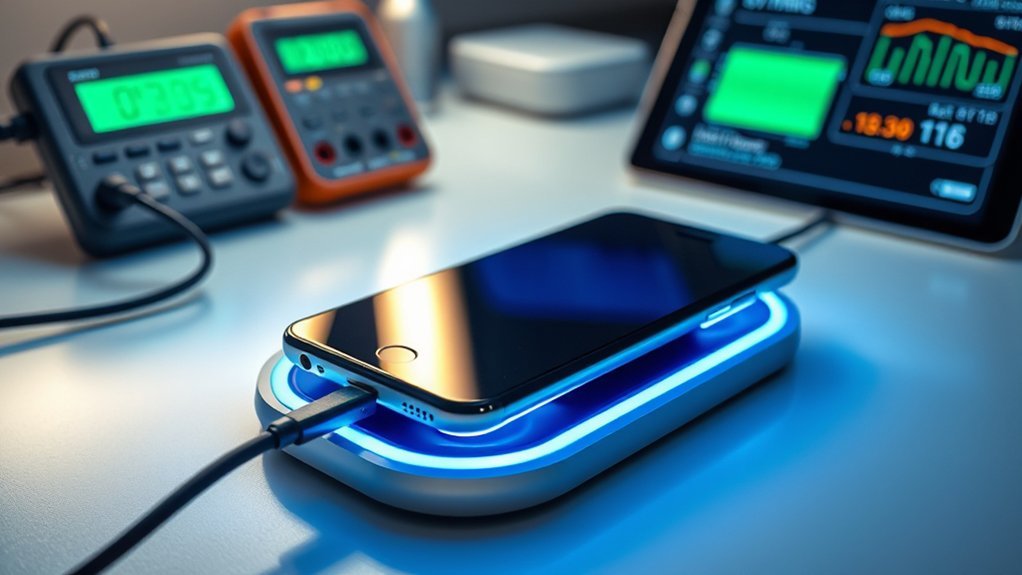
Several factors directly influence how quickly a device charges, impacting both user convenience and battery longevity. Key among these are battery health and power consumption. As a battery ages, its ability to accept high charging rates diminishes, reducing overall speed. High power consumption during charging can lead to thermal stress, which may degrade battery health over time. Additionally, the device’s charging circuitry and compatibility with fast-charging protocols determine maximum achievable speeds. Variations in input current, cable quality, and charger wattage also play vital roles. When power consumption remains high during charging, heat generation increases, further affecting battery longevity and slowing the charging process. Understanding these factors helps optimize charging strategies to balance speed with long-term device health.
How Can You Prepare Your Device for Faster Charging?
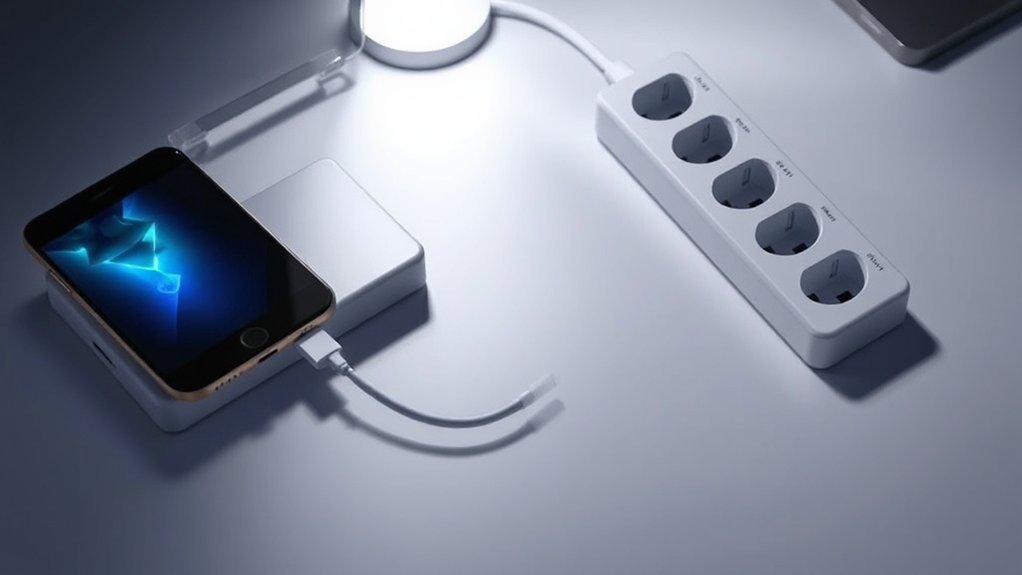
Preparing your device for faster charging involves optimizing both hardware and software conditions to guarantee maximum efficiency. Proper battery maintenance ensures the battery remains in excellent health, reducing internal resistance that hampers charging speed. Selecting compatible charging accessories, such as high-quality cables and chargers, minimizes energy loss and prevents bottlenecks. Additionally, keeping your device’s software updated ensures efficient power management and avoids background processes that slow charging. Here are four essential steps:
Optimize hardware and software for faster charging and better battery health.
- Use certified, high-quality charging accessories compatible with your device.
- Regularly perform battery maintenance by avoiding full discharges and keeping the battery between 20-80%.
- Close unnecessary background apps and disable power-intensive features during charging.
- Update your device’s firmware to enhance charging algorithms and overall power efficiency.
Implementing these strategies maximizes charging speed and prolongs battery lifespan.
Which Charging Technologies Can Boost Your Charging Speed?
Advancements in charging technology have considerably enhanced the speed and efficiency of power delivery to modern devices. Wireless charging, particularly through resonant and inductive methods, offers convenience but often lags behind wired solutions in speed. However, recent innovations have improved wireless charging standards, narrowing these gaps. Fast charging standards like USB Power Delivery (USB PD), Qualcomm Quick Charge, and others enable higher wattage transfer, reducing charging times markedly. These protocols dynamically adjust voltage and current to optimize charging speed while maintaining safety. By utilizing compatible fast charging standards, users can achieve rapid power delivery without risking device damage. While wireless options provide convenience, wired fast charging remains the most efficient method for maximizing charging speed, especially when paired with the latest fast charging standards.
What Common Mistakes Slow Down Charging and How to Avoid Them?
One common mistake that hampers charging speed is using incompatible or poor-quality cables and chargers, which can markedly limit current flow and voltage delivery. This directly impacts charging efficiency, risking battery safety and violating proper charging etiquette. To optimize speed, avoid these pitfalls:
Using poor-quality cables or chargers reduces charging speed and risks battery safety. Choose certified, compatible accessories.
- Using uncertified or damaged cables that increase resistance and reduce power transfer.
- Neglecting to match chargers with device specifications, leading to suboptimal current.
- Ignoring heat buildup during charging, which can slow down the process and compromise battery safety.
- Failing to update device firmware, preventing the use of advanced fast-charging protocols.
Frequently Asked Questions
Can Using a Higher Wattage Charger Damage My Device?
Using a higher wattage charger won’t damage your device if it’s designed for fast charging; it can actually improve power efficiency and battery longevity. Modern devices regulate power intake, preventing overcharging and safeguarding internal components effectively.
Is Wireless Charging as Fast as Wired Charging?
Wireless charging efficiency generally lags behind wired vs wireless speed, meaning wireless charging is usually slower. We find that wired connections deliver higher power transfer rates, optimizing charging speed, whereas wireless methods prioritize convenience over speed.
Do Temperature Changes Affect Charging Speed?
Like a delicate balance beam, temperature effects considerably impact charging efficiency; extreme heat or cold slows down the process, highlighting how temperature changes can hinder ideal charging speed by affecting battery chemistry and electrical resistance.
How Often Should I Calibrate My Battery for Optimal Charging?
We recommend calibrating your battery every 3-6 months, as calibration frequency directly impacts battery lifespan and charging accuracy. Regular calibration guarantees ideal charging efficiency, maintaining the battery’s health and preventing inaccurate readings that could hinder performance over time.
Are There Apps to Monitor and Improve Charging Performance?
Isn’t monitoring your battery like watching a crucial sign? Yes, apps like AccuBattery or BatteryCare track charging habits, helping optimize performance, extend battery lifespan, and fine-tune your charging routines through analytical insights.
Conclusion
In summary, optimizing charging speed involves more than just plugging in your device. By understanding the factors at play and choosing the right technologies, we can maximize efficiency without sacrificing battery health. It’s crucial to stay informed and avoid common pitfalls that slow down the process. When we strike the right balance, we guarantee our devices charge quickly and remain reliable—proof that sometimes, it’s better to be safe than sorry. After all, haste makes waste.