Ad Blocker Detected
Our website is made possible by displaying online advertisements to our visitors. Please consider supporting us by disabling your ad blocker.
Did you know that the internal resistance within a portable power station’s battery is responsible for a significant portion of energy loss, especially during high current flows? This resistance causes heat generation, which not only wastes energy but can also affect battery longevity. Understanding how these internal and external factors interact is vital for optimizing efficiency. Exploring these mechanisms reveals why careful design and environmental considerations are essential to get the most from your power station.
Key Takeaways
- Internal resistance in batteries causes heat and energy loss during charging and discharging processes.
- Conversion inefficiencies in inverters and power electronics lead to energy waste.
- Environmental temperatures impact internal resistance, affecting heat dissipation and overall efficiency.
- Excessive or improper charging practices can increase heat and reduce energy retention.
- Design choices, like high-quality components and thermal management, significantly reduce energy losses.
How Energy Is Lost in Portable Power Stations
Understanding how energy is lost in portable power stations is essential for optimizing their efficiency. Battery chemistry plays a significant role, as different chemistries have varying charge retention and discharge efficiencies, influencing overall energy loss. For instance, lithium-ion batteries typically exhibit lower internal resistance, reducing heat dissipation, whereas other chemistries may generate more heat and energy loss during operation. Additionally, the user interface impacts efficiency by affecting how effectively users manage device operation; a clear, responsive interface minimizes unnecessary power consumption caused by user error or indecision. Ultimately, analyzing these factors reveals that energy loss isn’t just about internal processes but also how users interact with the device, emphasizing the importance of optimized design and informed operation to improve overall energy retention.
Common Sources of Power Loss During Charging and Discharging
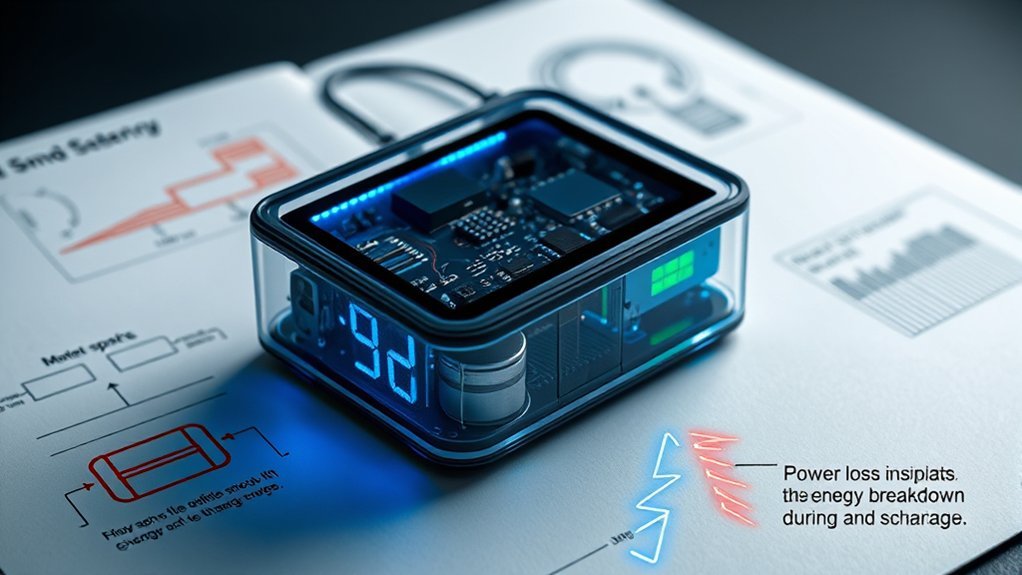
Power loss during charging and discharging processes is primarily driven by specific physical and chemical phenomena inherent to battery operation. Internal resistance, caused by electrode material properties and electrolyte conductivity, leads to energy dissipation as heat, reducing overall efficiency. Additionally, side reactions and electrolyte degradation contribute to capacity fade over time, impacting battery durability. These factors also influence user safety, as excessive heat buildup or chemical instability can pose risks. Electrode polarization and current leakage further cause minor but continuous energy losses, especially at higher charge rates. Understanding these sources helps us optimize design parameters to minimize energy waste, enhance battery lifespan, and guarantee safer operation. Addressing these fundamental phenomena is essential for improving overall portable power station performance and reliability.
How Conversion Inefficiencies Reduce Battery Life and Runtime
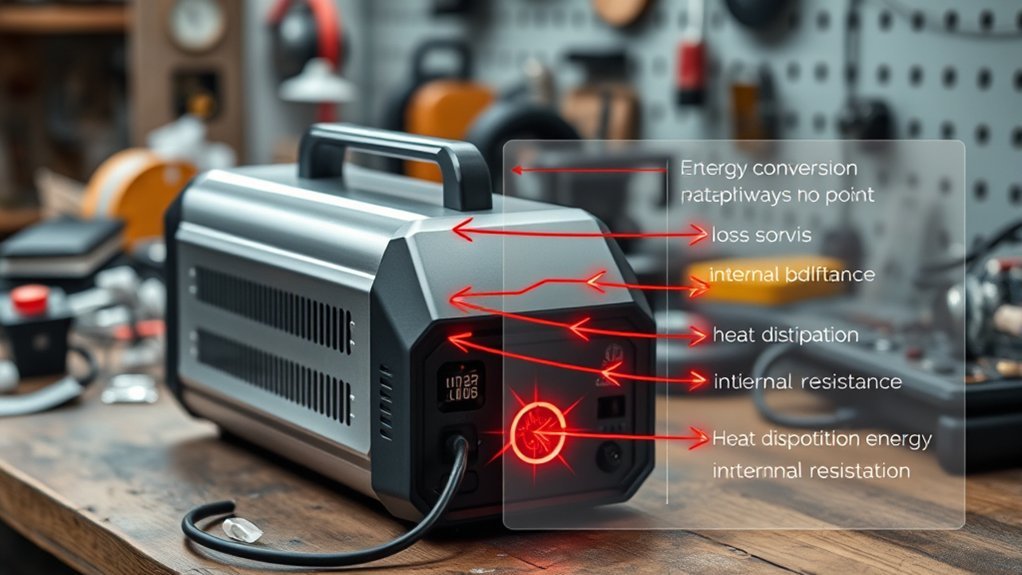
Conversion inefficiencies in battery systems cause a significant reduction in both lifespan and runtime by forcing energy to be lost during the process of transforming stored chemical energy into usable electrical power. These losses directly contribute to battery degradation, diminishing capacity over time. Ineffective energy calibration further compounds this issue, leading to over- or under-utilization of stored energy. The table below illustrates key factors:
| Factor | Impact |
|---|---|
| Conversion losses | Reduce available energy, accelerate degradation |
| Energy calibration | Causes inefficient energy use |
| Internal resistance | Increases energy loss, heats battery |
| Power electronics | Introduces additional inefficiencies |
| Cycle depth | Accelerates battery wear |
Understanding and minimizing these inefficiencies is essential to prolong battery life and optimize runtime.
The Impact of Temperature and Environmental Conditions on Energy Loss
Environmental conditions, particularly temperature, play an essential role in determining energy loss within portable power stations. Temperature effects influence battery chemistry, inverter efficiency, and thermal management, directly impacting overall performance. Specifically, environmental impacts include:
Temperature significantly affects energy efficiency in portable power stations, impacting battery life and thermal management.
- Increased resistance: Elevated temperatures raise internal resistance, causing higher energy dissipation as heat.
- Capacity degradation: Prolonged exposure to extreme temperatures accelerates battery capacity loss, reducing usable energy.
- Thermal management challenges: Cold environments lower chemical activity, decreasing efficiency, while heat requires active cooling, which introduces additional energy loss.
Understanding these temperature effects enables better assessment of environmental impacts on energy efficiency. As external conditions fluctuate, they considerably influence energy loss mechanisms, emphasizing the importance of monitoring and managing temperature for ideal portable power station operation.
Design Factors That Minimize Energy Waste in Portable Power Stations
We focus on implementing efficient power conversion techniques to reduce energy losses during voltage and current transformations. Optimizing battery management systems is essential for maintaining charge efficiency and prolonging overall system performance. Together, these design factors substantially contribute to minimizing energy waste in portable power stations.
Efficient Power Conversion Techniques
How can portable power stations achieve maximum efficiency in their power conversion processes? By employing advanced techniques that reduce energy waste, such as optimized power electronics, renewable integration, and wireless charging. These methods help maintain high conversion efficiency through precise voltage regulation and minimal losses. Specifically, 1. High-quality inverters with low switching losses ensure more effective AC/DC conversion. 2. Incorporating renewable energy sources, like solar panels, reduces reliance on grid power and enhances overall system efficiency. 3. Wireless charging systems, designed with minimal electromagnetic interference, enable seamless energy transfer with reduced conversion loss. These strategies collectively improve energy utilization, minimize waste, and enable portable power stations to operate closer to their theoretical maximum efficiency, providing reliable power with less energy loss.
Optimal Battery Management Systems
Effective battery management is fundamental to minimizing energy waste in portable power stations. By optimizing battery chemistry, we enhance energy storage efficiency and reduce internal losses. Proper management systems monitor and control charge/discharge cycles, preventing deep discharges and overcharging, which can degrade battery performance over time. Advanced systems employ precise voltage and temperature regulation, ensuring batteries operate within ideal parameters. This reduces heat generation and energy dissipation, directly improving overall efficiency. Additionally, intelligently balancing cells within the battery pack minimizes energy loss due to uneven charge distribution. Incorporating sophisticated algorithms allows for predictive maintenance and state-of-charge estimation, further limiting unnecessary energy expenditure. Ultimately, well-designed battery management systems extend battery lifespan and maximize energy retention, making portable power stations more reliable and energy-efficient.
Tips to Maximize Efficiency and Reduce Energy Losses
Optimizing charging practices guarantees minimal energy loss during the power transfer process, which is vital for maintaining efficiency. Additionally, reducing power conversion steps can considerably lower energy dissipation within the system. By focusing on these key areas, we can enhance overall performance and extend the operational lifespan of portable power stations.
Optimize Charging Practices
Have you considered that proper charging practices can substantially reduce energy losses in your portable power station? Implementing ideal charging protocols enhances charging safety and extends battery longevity. To achieve this, consider these strategies:
- Avoid frequent partial charges: Fully charging and discharging minimizes energy loss associated with partial cycles, preserving battery capacity.
- Use recommended chargers: Employ chargers with correct voltage and current ratings to prevent overvoltage or overheating, which reduces inefficiencies.
- Maintain ideal temperature: Charge within the manufacturer’s specified temperature range to prevent thermal losses and safeguard battery health.
Adhering to these practices ensures efficient energy transfer, reduces unnecessary energy dissipation, and prolongs the lifespan of your power station.
Minimize Power Conversion Losses
Did you know that power conversion processes are among the primary sources of energy loss in portable power stations? To maximize efficiency, we focus on minimizing these losses by optimizing the conversion circuitry and selecting high-quality inverters. Efficient power conversion enhances battery durability by reducing heat generation and stress on internal components, ultimately extending lifespan. Properly managing power storage also plays a vital role; by matching input and output voltages and avoiding unnecessary conversions, we limit energy dissipation. Using advanced electronics with low equivalent series resistance (ESR) and implementing smart regulation techniques further reduces conversion losses. These measures not only preserve the stored energy but also guarantee that more power reaches your devices, improving overall system efficiency and reliability.
Frequently Asked Questions
How Do Battery Chemistry Types Affect Energy Loss in Portable Power Stations?
Different battery chemistries impact energy loss through variations in battery lifespan and thermal management efficiency, with lithium-ion offering lower losses due to better thermal stability, while lead-acid batteries tend to dissipate more energy, reducing overall efficiency.
What Role Do Inverter Quality and Design Play in Energy Efficiency?
We find that high-quality inverters with superior durability and innovative design reduce energy losses, like in our case study where advanced design innovations improved efficiency by 15%, highlighting the critical role of inverter quality in optimizing portable power station performance.
Can Software Optimizations Improve Power Station Energy Retention?
Software optimizations can enhance energy retention by managing charging cycles and reducing battery stress, thereby extending battery lifespan and improving overall efficiency; these intelligent controls minimize power loss during operation and optimize power flow dynamics.
How Does User Handling Impact Energy Loss During Operation?
User handling, especially improper charging methods, substantially impacts energy loss during operation. We observe that correct handling minimizes losses, while mishandling, such as overcharging or using incompatible chargers, accelerates energy depletion and reduces overall efficiency.
Are There Specific Accessories That Can Reduce Overall Energy Waste?
We believe specialized accessories, like high-efficiency solar panels and advanced energy monitoring systems, can cut down waste considerably. They help us stay ahead of the game by optimizing power input and spotting losses early.
Conclusion
Ultimately, understanding energy loss in portable power stations is like tending a delicate garden—we must nurture each element carefully. By optimizing design, managing temperature, and guaranteeing efficient operation, we safeguard the core energy reservoir, allowing it to flourish. Minimizing losses isn’t just about saving power; it’s about cultivating resilience and longevity. When we address these factors with precision, we make certain our energy “seed” grows stronger, ready to power our every need with unwavering reliability.